Resources / Insights
Retaining Waste Precious Metals in the UK Is a Matter of National Interest

Gold, precious metals, and rare earth minerals are of strategic importance. Can e-waste provide a source for shoring up these resources?
In October 2025, gold surged to over US$4,000 an ounce, its highest value surge since 1979. 1979 was a year of geopolitical volatility, rocketing inflation, and economic and social turbulence – the parallels with today are clear. Gold is considered a safe haven by some investors, and its rising value may reflect scepticism over the strength of reserve currencies like the US dollar, as well as other perceived ‘safe haven’ assets like government bonds.
It is not just institutional and retail investors that are driving renewed interest in gold. The price has been rising steadily for years, as central banks have been collectively buying more than 1,000 tonnes per year since 2022. Central banks now hold a total of more than 36,000 tonnes of gold, making it the world’s second reserve currency, ahead of the euro and behind the US dollar, at US$4.5 trillion.
Given the strategic geopolitical and economic importance of gold, it is important to have a conversation about the amounts of gold and other precious metals leaving the country in the form of e-waste. The UK is generating 1.6 million tonnes of e-waste annually, of which less than 20% is recycled. One tonne of printed circuit boards (PCBs) contains 165 grammes of gold, meaning that tonnes of gold are being lost every year, either left in e-waste or exported to other countries.
What is driving the increase in gold prices?
Gold has achieved a string of record highs in 2025 and some experts predict prices could continue to rise. To better understand the market landscape, we must understand the specific factors driving this increase:
1. Inflation and Interest Rates: Simply put, our money is buying us less. Prices have been rising since 2022, when inflation reached a record high at 11%. This has largely been driven by geopolitical uncertainty and spending during the pandemic. Some see gold as a hedge against inflation, expecting it to rise in value as inflation erodes the value of cash.
In response to high inflation, central banks increased interest rates. As inflation now seems to be settling closer to the 2% target, central banks have been cutting interest rates. Lower interest rate environments are often perceived as good for gold because government bonds (another ‘safe haven’ asset) pay lower yields which reduces the opportunity cost of holding gold (which doesn’t pay a yield).
2. Trade instability: The US administration’s implementation of wide-ranging tariffs have had a significant impact on markets around the world. Heightened economic uncertainty make gold an attractive option for those concerned about the impact of trade wars on currencies and investment portfolios.
3. Geopolitical uncertainty: In times of geopolitical uncertainty and conflict, it is observed that investors put money into gold to guard against unpredictable market fluctuations.
4. AI bubble: AI and big tech stocks increasingly account for an out-sized share of the stock markets, and many analysts including the Bank of England, fear that this has created a high degree of risk should attitudes towards the technology change. The rise in gold prices may be seen as an attempt to diversify investment portfolios against this risk.
UK e-waste: A strategic source of gold?
We can see that times of uncertainty may drive up gold prices. And we can see that an increasingly multipolar world is creating greater uncertainty. For some investors, gold provides a strategic layer of defence against extreme outcomes.
There is a clear source of gold strategically available to the UK. As the world’s second worst creator of e-waste globally, the UK has large supplies of waste gold trapped in PCBs. Most of this e-waste is not recycled in the UK, and consequently much of this gold is lost. This represents a significant squandered opportunity.
Much of the UK’s e-waste, especially smaller items, ends up directly in the bin according to the Department for the Environment, Food and Rural Affairs (DEFRA), rather than reused or recycled. And while up to 80% of large appliances like fridges are recycled, less than 20% of smaller appliances are.
A 2019 report found that much of the UK’s e-waste is exported illegally to developing countries. As much as 500,000 tonnes of UK e-waste are illegally exported each year, which is not only a loss for the UK recycling industry, but also a huge environmental risk to the countries where it ends up and is not properly treated.
In 2020, the UK generated approximately 24.9 million discarded mobile phones, while The World Economic Forum estimates that there is 100 times more gold in a tonne of mobile phones than in a tonne of gold ore. This represents a massive opportunity for the UK to retain precious metals for its own economy.
The government has introduced legislation, under the amended Waste Electrical and Electronic Equipment (WEEE) regulations of 2025, to ensure better handling of e-waste items by requiring producers to take responsibility for the end-of-life journey of their products. Nevertheless, up to 20kg of waste electronics per capita remain in UK homes.
If this e-waste problem were tackled, and all items fully and properly recycled, it would be a significant step forward for the UK retaining precious metals domestically. And in an uncertain future global environment, this could be of vital strategic importance.
Retaining and storing critical rare earth minerals
The UN has previously reported that global annual e-waste is believed to contain 130 tonnes of critical raw materials from less scarce elements like palladium and lithium, to the 17 magnetic lanthanide rare earth minerals like scandium, yttrium and europium.
These rare earth minerals are increasingly in the news as the US and China face-off over access to them. According to The International Energy Agency, China produces around 61% of rare earth minerals, and controls 92% of their processing. These minerals are critical to the US for both high-tech manufacturing and defence technologies, 70% of which the nation imports from China.
Given the amount of these minerals in e-waste, salvaging them is an opportunity for the UK. Access to these materials is likely to be a key political and economic advantage in the century to come.
Reformation Metals and the potential for reclaimed gold
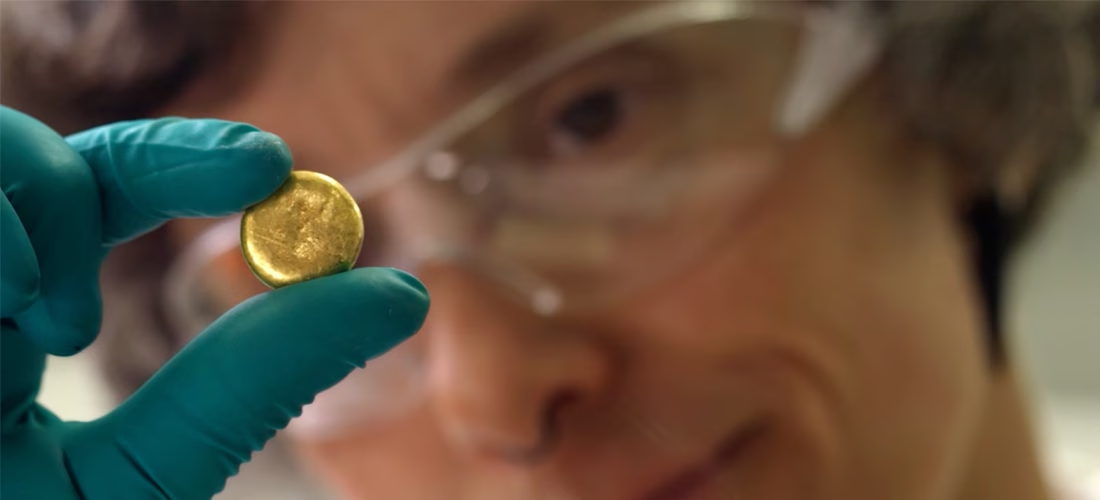
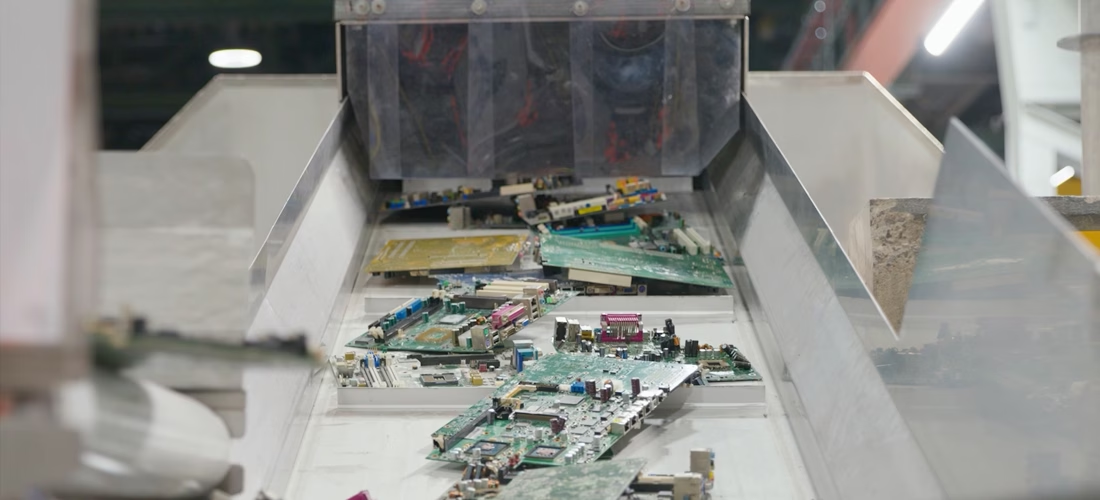
The Royal Mint’s Reformation Metals has the capacity to process up to 4,000 tonnes of PCBs per year, and we are rapidly building capacity to process up to 10,000 tonnes. Combining The Royal Mint’s expertise both in mechanical engineering and precious metals with a revolutionary new chemical solution from Canadian clean-tech company Excir, Reformation Metals can recover 99% of gold from PCBs.
Reducing the reliance smelting, and with a reusable chemical composition for reclaiming gold, this process has 1/10,000th the carbon footprint of newly mined gold, and produces gold ingots of 99.99% purity.
Running at full present capacity of 4,000 tonnes of PCBs per year, Reformation Metals has the potential to reclaim up to 500kg of gold, 2,500kg of silver, 1,000kg of copper and 55kg of palladium. We are working with recyclers to ensure maximum recovery and maximum value from e-waste. This collaboration means that huge quantities of precious metals can be retained in the UK.
To learn more about how The Royal Mint’s Reformation Metals works to help tackle the UK’s e-waste problem, and how you can be part of it, talk to our team and arrange a facility tour.